
Condition monitoring can be performed in different ways, depending on how often data is collected and how analysis is organized. The most common methods are periodic condition monitoring, online condition monitoring, and analysis on demand. These methods are often combined within one monitoring program, especially when monitoring is expanded across larger asset groups. Increasingly, organizations want to move toward continuous, data driven machine health insight across larger fleets of rotating equipment. This shifts the focus from isolated measurements to scalable monitoring and analysis.
Periodic condition monitoring
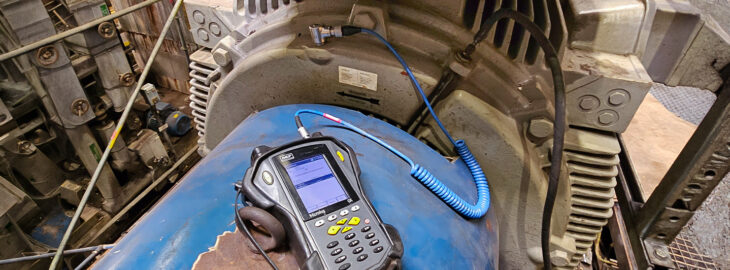
Periodic condition monitoring identifies changes in vibration behavior by taking measurements at predefined intervals. The interval is typically defined based on the application, the criticality of the equipment, and the expected failure modes. With this method, vibration data is collected on site using portable measurement equipment. By measuring at fixed intervals, trend data can be generated and stored together with relevant technical information about the machine.
Periodic monitoring can be an economical starting point because it requires limited upfront investment. In many cases, it does not require permanently installed sensors or monitoring hardware, as measurements are taken with portable equipment. The trade-off is that periodic data represents snapshots of machine behavior. Because the machine is not monitored continuously, there is no full visibility of condition development between measurement moments, and short duration events or fast developing faults may be missed. For that reason, periodic monitoring is mainly suitable for trend indication and selective coverage. In practice, it is also often the starting point from which monitoring is later expanded when continuous insight across a broader asset base becomes valuable.
“During critical moments like run up, coast down and critical speeds, the data collection frequency can be increased to enhance machine insights and maximise process control and reliability.”
Sander Bakker
CONDITION MONITORING SPECIALIST (ISO 18436-2 LEVEL 4)
Online condition monitoring
Online condition monitoring refers to continuous monitoring using permanently installed hardware. Vibration data is collected continuously during normal operation, providing direct insight into machine behavior over time. During operating phases where additional details are valuable, data acquisition can be increased to improve insight into machine behavior.
Within an online monitoring system, vibration limits can be configured to trigger alarms. These limits are intentionally set well below machine protection thresholds, so they are triggered before protection limits are approached. Exceeding a condition monitoring limit does not necessarily indicate an immediate risk, but can indicate developing wear, abnormal behavior, or the need for further analysis. Online monitoring is no longer limited to only the highest critical assets. As the demand for machine health data grows, continuous monitoring is increasingly applied across a larger group of rotating assets, where availability, performance, and maintenance efficiency are becoming increasingly important.
Online monitoring provides continuous visibility, but its value depends on the ability to review incoming data consistently and turn it into decisions. As monitoring coverage expands, this requirement increasingly drives the need for a scalable analysis method.
Analysis on demand
As monitoring coverage grows, reviewing all data manually becomes inefficient and difficult to scale. In practice, analysis on demand means that expert review is triggered when a relevant deviation is detected, when a monitoring alarm is raised, or when additional analysis is requested for a specific asset.
When an automated first line analysis layer is available, incoming data can also be screened continuously and assets can be flagged automatically for further review.
This supports prioritization and helps keep specialist time focused on the cases where expert interpretation adds the most value.
In modern condition monitoring, the challenge is no longer only how to collect data, but how to create actionable insight across a growing number of assets. That is why periodic monitoring, continuous monitoring, and analysis on demand are increasingly used together rather than seen as separate choices.
