
In downstream oil and gas facilities such as refineries, tank terminals, and petrochemical plants, compression and airflow equipment is essential for safe and stable operations. Cooling tower and process fans, blowers, and compressors support critical functions including heat rejection, combustion air supply, vapor recovery, and gas handling. These assets operate continuously as part of larger process systems, where loss of airflow or compression capacity can directly affect production stability, energy efficiency, and safety.
From an asset reliability perspective, this equipment represents a large population of rotating machinery with varying criticality. While some compressors are considered high-impact assets, many fans and blowers are operationally critical but lack continuous condition monitoring. Ensuring reliable operation across this asset group requires a scalable vibration monitoring approach aligned with downstream operational realities.
The challenge
Cooling tower and process fans, blowers, and compressors in downstream environments are exposed to continuous operation, fluctuating process loads, and harsh ambient conditions. Cooling tower fans are subject to moisture, corrosion, and structural vibration, while process fans and blowers often operate close to their design limits under variable flow conditions. Compressors experience dynamic forces related to pressure changes, gas composition, and speed variations.
Typical failure mechanisms include bearing degradation, rotor imbalance, misalignment, mechanical looseness, and resonance. These faults often develop gradually and are difficult to detect with periodic inspections alone. Access limitations, hazardous area classifications, and the large number of installed units further complicate manual vibration routes. As a result, early-stage mechanical issues may remain unnoticed until vibration levels increase enough to cause secondary damage or unplanned downtime.
Why vibration monitoring matters in this application
Vibration monitoring is a proven method for assessing the machine condition of rotating equipment used for compression and airflow. Changes in vibration behavior provide early fault detection for common degradation mechanisms such as bearing wear, imbalance, shaft misalignment, and structural issues in fan and compressor assemblies.
For downstream oil and gas operators, continuous vibration monitoring enables condition-based maintenance by identifying developing faults before they affect airflow performance, cooling efficiency, or compression stability. Compared to reactive maintenance or time-based inspections, vibration monitoring supports predictive maintenance strategies that improve rotating equipment reliability and reduce the risk of process interruptions across large asset fleets.
 [Click to enlarge]

The solution – VibSys® for downstream compression and airflow equipment
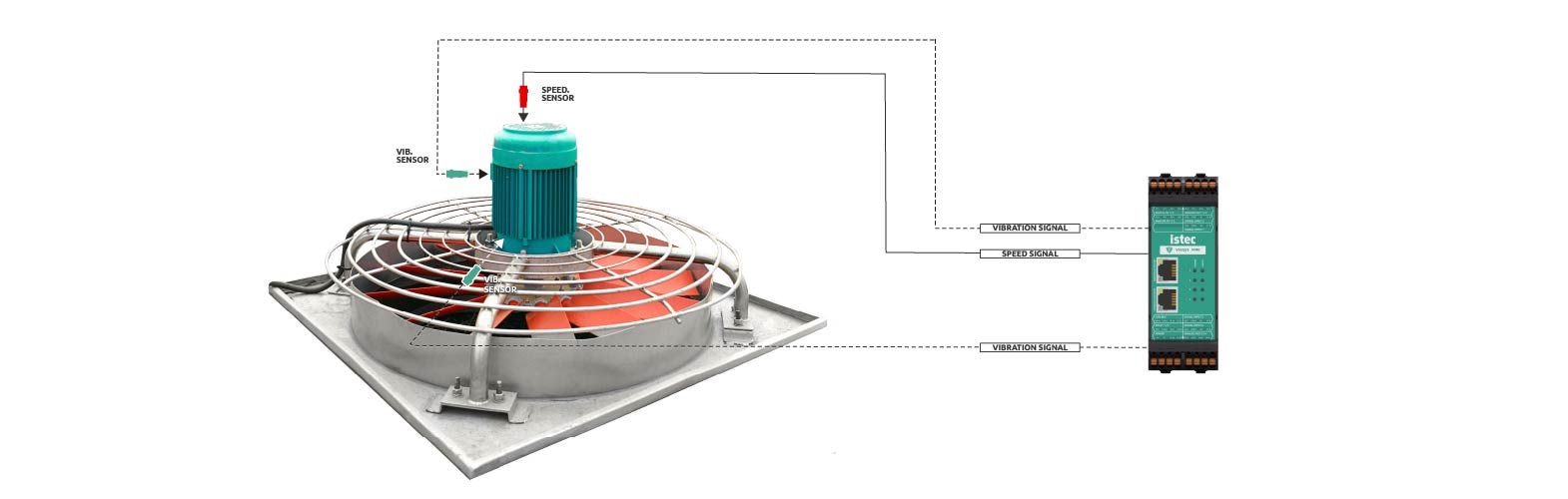
VibSys® is a compact vibration monitoring system designed for accessible and scalable condition monitoring of rotating equipment such as cooling tower fans, fans, blowers, and compressors. The system continuously acquires high-quality vibration data and performs onboard signal processing to deliver meaningful condition indicators directly at the asset level.
In downstream oil and gas applications, VibSys can be deployed on bearing housings, gearboxes, or motor frames, using standard industrial vibration sensors. Local processing allows for real-time monitoring and alarming, while vibration data can be integrated into control systems or external analytics platforms via open interfaces such as Modbus and APIs. This open architecture supports gradual expansion and avoids vendor lock-in, which is particularly relevant for large fan and compressor populations spread across a site.
VibSys fits well with monitoring strategies for mid-range and operationally critical assets, providing continuous insight without the complexity of traditional high-end protection systems.
Key advantages:
- Continuous vibration monitoring of cooling tower fans, fans, blowers, and compressors across distributed installations
- Early detection of bearing wear, imbalance, misalignment, and mechanical looseness under variable operating conditions
- Compact and robust hardware suitable for harsh downstream environments, including outdoor and high-humidity locations
- Onboard signal processing enabling local alarms and trend-based condition assessment
- Open integration with plant systems and external diagnostic platforms, supporting scalable condition monitoring strategies
Impact on maintenance and asset reliability
Applying VibSys for vibration monitoring on compression and airflow equipment allows downstream oil and gas operators to transition from reactive maintenance to condition-based maintenance. Maintenance teams gain continuous visibility into machine condition, enabling better planning of inspections, overhauls, and spare parts logistics based on actual asset health.
Over time, this leads to improved rotating equipment reliability, reduced unplanned downtime, and increased confidence in the availability of critical airflow and compression systems. By combining scalable deployment with reliable vibration data, VibSys supports predictive maintenance strategies that align with the operational and economic requirements of downstream oil and gas facilities.
