
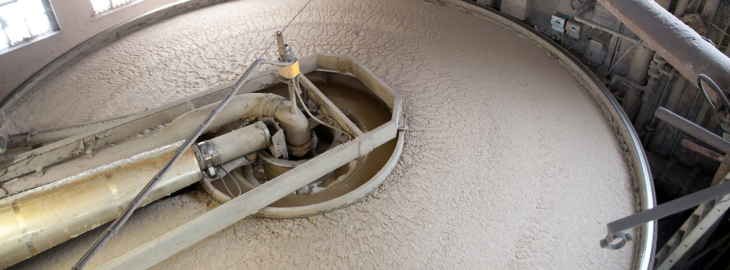
Pulp preparation is a continuous and mechanically demanding part of pulp and paper production. Equipment such as pulpers, screens and refiners, stock and pulp pumps, vacuum pumps, mixers and chest agitators, and centrifugal cleaners operates around the clock while handling abrasive fibre suspension with varying consistency and frequent process changes. These machines form the mechanical backbone of stock preparation, directly influencing flow stability, fibre quality and the operational margin of downstream paper machines.
From an asset reliability perspective, pulp preparation consists of many mid‑critical rotating assets whose combined condition determines process stability. Small mechanical degradations can quickly translate into quality variability, unstable stock flow or lost capacity. Vibration condition monitoring therefore plays an important role in maintaining predictable operation and supporting condition‑based maintenance in this part of the mill.
The challenge: variable process conditions and distributed assets
Pulp preparation rarely runs at a single steady operating point. Consistency, fibre type, reject load, dilution water and production rate change continuously, and many machines switch between different operating modes such as filling, circulating, deflaking, screening and refining. As a result, vibration levels naturally vary with the process.
This makes reliability management challenging in practice. Without continuous trending, it is difficult to distinguish between vibration changes caused by normal process variation and those caused by developing mechanical faults. A manual vibration route taken under a different load or consistency may miss early degradation or lead to unnecessary follow‑up.
The risk is spread across a wide range of assets that keep stock moving and conditioned. Issues in stock and pulp pumps can introduce flow instability or cavitation damage. Problems with mixers and chest agitators can lead to poor mixing and quality variation. Mechanical degradation in screens or refiners can force throughput reduction or affect fibre treatment. Individually these machines are often not classified as highly critical, but together they drive maintenance workload, quality risk and production loss.
At the same time, scaling traditional high‑end vibration systems across dozens of rotating assets is often impractical, while simple sensors without diagnostics provide limited insight. A practical pulp preparation monitoring strategy therefore requires continuous condition monitoring with usable diagnostic information, applied across more machines and usable by teams with limited time for deep vibration analysis.
Why vibration monitoring matters in pulp preparation
Vibration monitoring is particularly effective in pulp preparation because many failure mechanisms develop mechanically long before they appear in process values or alarms. Changes in vibration behaviour often provide the first indication of bearing wear, looseness, misalignment or hydraulic problems.
In stock and pulp pumps, vibration monitoring supports early detection of bearing degradation, imbalance, misalignment and hydraulic phenomena such as cavitation. In refiners and screens, vibration trends can reveal abnormal rotor‑stator interaction, mechanical looseness or developing resonance conditions. For mixers, chest agitators and auxiliary drives, vibration monitoring helps identify wear and alignment issues before they result in poor mixing or repeated maintenance interventions.
By monitoring vibration continuously under real operating conditions, mills gain objective machine condition insight that complements process data and supports condition‑based and predictive maintenance decisions.
Applying VibSys® in pulp preparation

VibSys® is designed for continuous vibration condition monitoring and diagnostics on rotating equipment, with a focus on accessibility and scalability. This fits well with the type and number of assets typically found in pulp preparation. VibSys® captures high‑quality vibration signals and per
forms processing at the machine, allowing consistent condition indicators to be trended even when operating conditions change .
Because pulp preparation equipment operates under varying load and consistency, local signal processing is essential. VibSys® converts raw vibration behaviour into clear machine‑condition indicators close to the asset, reducing sensitivity to momentary process changes while retaining diagnostic depth when mechanical behaviour starts to drift. This supports early fault detection for bearing degradation, looseness, misalignment, resonance and hydraulic‑related vibration in pumps, as well as abnormal interaction patterns in refiners and screens.
Scalability is a key consideration in pulp preparation. VibSys® is installed at the machine and can be deployed across multiple pumps, agitators, refiners and auxiliary drives without redesigning the full monitoring infrastructure. Open interfaces allow condition indicators and, where required, vibration time signals to be integrated with existing CMMS systems, historians or analysis platforms. VibSys® is intended strictly for condition monitoring and diagnostics to support maintenance decision‑making, not for protection or shutdown functions.
Key advantages for pulp preparation equipment
- Continuous vibration condition monitoring across pulpers, pumps, refiners, screens and agitators
- Condition indicators that remain usable under changing operating modes and process variation
- Early fault detection of bearing wear, misalignment, looseness and hydraulic‑related vibration
- Practical scalability for large numbers of mid‑critical rotating assets
- Machine‑side installation suited to wet, industrial pulp preparation environments
- Open integration options to support condition‑based and predictive maintenance workflows
Impact on maintenance, quality and reliability
Applying vibration condition monitoring with VibSys® in pulp preparation supports a shift from reactive maintenance and fixed‑interval work to condition‑based maintenance. Instead of responding to failures or late‑stage symptoms, maintenance teams can follow machine condition trends continuously and intervene when indicators show clear degradation.
This reduces the risk of unplanned downtime, secondary damage and quality disturbances caused by late‑stage bearing damage, looseness or hydraulic problems. It also improves maintenance planning, as parts and labour can be scheduled around production and targeted at the assets that actually show deterioration. By extending vibration monitoring across pulpers, refiners, stock and pulp pumps, and supporting drives, mills gain earlier visibility into rotating equipment reliability and create a practical foundation for predictive maintenance in pulp and paper production.
Free online vibration training
If your team is responsible for maintenance and reliability of rotating equipment in pulp and paper, basic vibration knowledge makes it easier to act on condition monitoring results. Istec provides a free Vibration Category 1 online training via the Istec Academy for professionals who want a practical introduction to vibration fundamentals and typical machine fault patterns.
Learn more »