
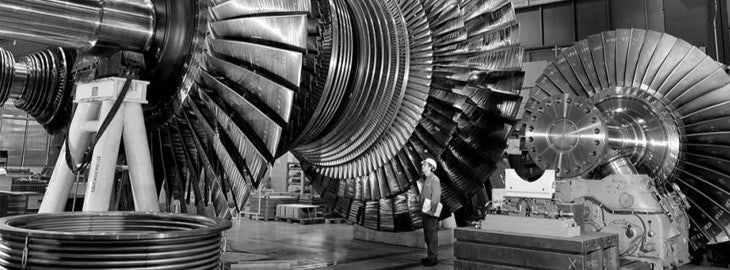
Gas-fired power plants rely on a wide range of rotating equipment to maintain reliable and efficient electricity production. While gas turbines are at the center of the generation process, overall plant performance depends heavily on supporting assets such as compressors, pumps, fans, generators, and auxiliary gearboxes. The reliability of these assets directly influences plant availability, maintenance costs, and operational performance. Continuous vibration monitoring helps maintenance teams gain visibility into machine condition and identify developing faults before they affect production.
The challenge: maintaining reliability across supporting systems
Gas power plants operate under demanding conditions, including continuous operation, load fluctuations, start-stop cycles, and changing process requirements. These conditions place constant stress on rotating equipment throughout the facility.
Compressors are often used in fuel gas handling and auxiliary process systems, while Pumps support cooling, lubrication, and utility processes. Fans are responsible for ventilation, cooling, and air management, while Generators and supporting Gearboxes contribute directly to power production and equipment availability.
Many of these assets are monitored through routine inspections or periodic measurements. As a result, developing issues such as bearing wear, imbalance, misalignment, looseness, and gear degradation may remain unnoticed until machine performance is affected or unexpected downtime occurs. Continuous visibility into machine condition is therefore essential for maintaining asset reliability across the plant.
Why vibration monitoring matters in gas power generation
Vibration monitoring is one of the most effective techniques for assessing the condition of rotating equipment. Most mechanical failures develop gradually and generate detectable vibration signatures long before functional failure occurs. Continuous vibration monitoring enables early fault detection and provides valuable insight into machine condition.
For Compressors, vibration monitoring can reveal bearing degradation, imbalance, coupling issues, and alignment problems before reliability is affected. Within Pumps, vibration behaviour often indicates developing bearing damage, hydraulic-related vibration effects, or mechanical looseness.
For industrial Fans, vibration analysis helps identify imbalance, bearing wear, and structural looseness before airflow performance declines. Generators and Gearboxes benefit from condition monitoring through earlier detection of bearing defects, gear wear, and drivetrain-related faults.
By identifying these issues at an early stage, maintenance teams can move from reactive maintenance towards condition-based maintenance and predictive maintenance strategies based on actual machine condition. This improves maintenance planning and supports long-term rotating equipment reliability.
Applying VibSys® in gas power generation
VibSys® is designed to make continuous vibration monitoring practical across larger populations of rotating equipment. Rather than focusing exclusively on the most critical machinery, VibSys® extends condition monitoring coverage to the supporting assets that significantly influence plant reliability.
Within gas power generation facilities, VibSys® can be applied across Compressors, Pumps, Fans, Generators, Gearboxes, and other auxiliary rotating equipment. The compact DIN-rail architecture allows installation close to the machine, reducing infrastructure requirements while simplifying deployment across the facility. Continuous vibration data is processed locally and converted into practical machine-condition indicators that support maintenance decision-making.
A key advantage is scalability. Gas power plants often contain large populations of supporting equipment that fall between periodic route measurements and high-end monitoring systems. VibSys® bridges this gap by providing continuous condition monitoring without the complexity traditionally associated with centralized vibration monitoring infrastructure.
The system supports open integration through standard interfaces and APIs, allowing vibration data and condition indicators to be incorporated into existing maintenance platforms, analytics environments, and reliability programs. This enables facilities to expand machine condition visibility without creating vendor lock-in.
VibSys® is intended for condition monitoring and diagnostics. It supports predictive maintenance programs by providing continuous insight into machine condition and early fault detection across supporting rotating equipment.
Key advantages
- Continuous vibration monitoring of Compressors, Pumps, Fans, Generators, and Gearboxes.
- Early fault detection of bearing wear, imbalance, misalignment, and gear degradation.
- Scalable deployment across large populations of supporting plant equipment.
- Local processing delivers practical machine-condition indicators at asset level.
- Open integration with maintenance systems, cloud platforms, and third-party environments.
- Supports condition-based maintenance and predictive maintenance strategies.
Impact on maintenance and reliability
Applying vibration monitoring with VibSys® gives maintenance teams earlier visibility into developing faults across supporting rotating equipment throughout the gas power plant. Instead of discovering mechanical issues during routine inspections or after failures occur, maintenance teams gain continuous insight into changing machine condition.
In practice, this supports a shift from reactive maintenance toward condition-based maintenance. Maintenance resources can be prioritized more effectively, interventions can be planned based on actual asset condition, and the risk of unexpected failures can be reduced.
For gas power generation facilities, continuous vibration monitoring provides a practical foundation for improved asset reliability, predictive maintenance, and better-informed maintenance decisions across Compressors, Pumps, Fans, Generators, and Gearboxes.
