

Evonik operates a hydrogen reciprocating compressor installation at its Antwerp site in Belgium.
In 2020, rod drop monitoring for rider band wear was implemented on two cylinders of this compressor using an Istec RecipSys 200 system, replacing an obsolete rod drop monitoring solution. Following several years of stable and reliable operation, the RecipSys 200 became the established monitoring platform for piston rod displacement on this installation.
To achieve full monitoring coverage, Evonik decided to extend the existing rod drop monitoring to include all four cylinders of the compressor. Istec was commissioned to support this extension through sensor installation, configuration, commissioning and subsequent system improvements, fully aligned with the existing measurement philosophy.
Challenge: Full condition monitoring for all compressor cylinders
The existing rod drop monitoring covered only part of the compressor installation. With two cylinders already monitored, the remaining cylinders required the same level of condition monitoring to ensure consistent measurement behavior, alarm handling and operator interpretation across the entire machine.
The challenge was to extend the rod drop monitoring in a way that:
- maintained the existing rod drop measurement concept
- integrated seamlessly with the existing control and protection infrastructure
- provided reliable piston rod displacement monitoring as an indicator of rider band wear
- ensured correct communication and visualization of all signals in the DCS
The objective was not to introduce a new monitoring concept, but to extend a proven and trusted solution already in operation.
Solution: Expansion of rod drop monitoring with RecipSys 200
The rod drop monitoring was extended by adding a second RecipSys 200, increasing the monitoring coverage from two to four cylinders on the hydrogen reciprocating compressor.
The RecipSys 200 hardware was installed by Evonik as part of the overall system integration. Istec aligned the extension fully with the existing monitoring architecture and measurement philosophy already in use at the site.
By applying the same configuration approach and measurement principles, the additional cylinders could be monitored in exactly the same way as the existing ones, without introducing changes for operators or maintenance personnel. All rod drop information was made available through the existing plant DCS.
Execution: Installation and commissioning of rod drop monitoring
Istec carried out the installation of the rod drop sensors and performed the configuration and commissioning of the monitoring system on site.
During commissioning, the rod drop measurements were configured by establishing a mechanical reference point for each cylinder using the existing phase reference on the flywheel. This reference point was used to define the zero position of the measurement.
Based on this reference, alarm and trip levels were configured to detect excessive piston rod displacement caused by rider band wear. A remaining wear margin of 4 mm was applied before piston‑to‑cylinder contact.
All measurements, alarms and trip functions were tested during commissioning. Signal transmission and visualisation were verified from the monitoring system up to the DCS.
During testing, a visual inversion between two rod drop measurements was identified on the DCS display and corrected after the site visit.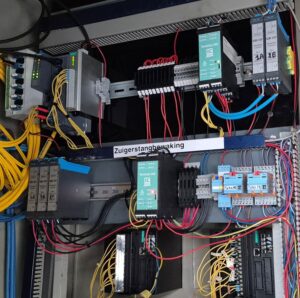
During this phase, Istec also identified that the cabinet layout was not fully aligned with the original design documentation. This included unused wiring and insufficient separation between ATEX and non‑ATEX components. These findings were documented as improvement recommendations.
At a later stage, Istec returned to site and implemented the recommended improvements, bringing the cabinet layout in line with the original design intent and ATEX separation requirements.
Key deliverables: Results of the monitoring expansion
- Extension of rod drop monitoring coverage from two to four cylinders
- Installation of rod drop sensors on the additional cylinders
- Configuration and commissioning of RecipSys 200‑based rod drop monitoring
- Definition of measurement zero using phasor trigger‑based reference
- Configuration of alarm and trip levels based on allowable rider band wear
- Verification of signal transmission and visualization in the DCS
- Identification and documentation of cabinet layout and ATEX compliance issues
- Implementation of cabinet layout improvements in line with recommendations
Impact: Reliable and consistent compressor monitoring
The rod drop monitoring extension was successfully commissioned and integrated into the existing control system. All measurements, alarms and trip functions were tested and verified, and correct signal presentation in the DCS was confirmed.
Following the extension and subsequent cabinet improvements, the compressor installation is now equipped with a consistent and maintainable rod drop monitoring setup across all four cylinders, based on a proven and familiar monitoring concept.
Conclusion: Scalable extension of a proven monitoring concept
This project demonstrates Istec’s ability to extend proven rod drop monitoring solutions on operating reciprocating compressor installations in a controlled and consistent manner.
By building on an established monitoring platform and combining sensor installation, configuration, commissioning and follow‑up improvements, Istec delivered a technically robust extension that fits seamlessly into the existing installation and monitoring philosophy.
