

Vibration monitoring has long been a proven method to gain critical insights into machine health and prevent unplanned downtime. Yet it is still far from being a standard for every rotating machine. At the top end of the market, you will find complex systems with SIL‑certified protection functionality, essential for critical assets such as large gas turbines and compressors. These solutions are expensive and complex, but necessary to ensure safety and continuity.
At the other end, simple measurement devices and wireless sensors offer affordable alternatives. They work well for some non-critical machines, but for semi critical assets they provide data that is neither complete nor reliable enough to support predictive maintenance strategies. Between these extremes lies a vast mid-range segment consisting of pumps, fans, smaller turbines and auxiliary systems. Many of these machines are still monitored using handheld instruments. While those measurements can be accurate, they lack continuity due to long intervals between readings, leaving significant gaps in the data. VibSys® was developed to close that gap.
What makes VibSys® truly accessible
Accessibility is not only about bridging the gap. It is about removing the barriers that prevent organizations from implementing continuous vibration monitoring across their plant.
VibSys® begins by eliminating vendor lock in. With its open architecture and API, it integrates seamlessly with existing systems and data environments, giving organizations full control over where and how their machine data is used.
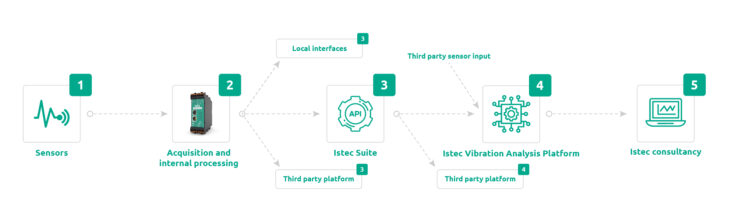
Technical accessibility matters too. VibSys® is easy to integrate into existing setups and can be fully tailored to customer needs. It is built in a compact housing designed for DIN‑rail mounting, making installation straightforward and space‑efficient. No extra cabinets, no complex rewiring, just a clean fit into existing infrastructure.
Finally, VibSys® processes all vibration data onboard, performing up to 64 extractions per channel. Instead of sending raw signals to external systems for interpretation, the device converts them into actionable insights at the source. This reduces system complexity and allows teams to work with clear, structured information. The combination of open connectivity, smart hardware design, and local intelligence results in a solution with a low financial footprint, making predictive maintenance achievable for the entire mid‑range segment.
Practical example: gas turbine and supporting systems
Imagine a power plant with a large gas turbine at its core. This turbine is monitored by a high‑end system, as it should be. But around it operates a wide range of Balance of Plant (BoP) assets. Some of these, such as pumps and fans, directly support the turbine itself, while others support the broader process of converting fuel, such as gas, into electricity. When any of these BoP components fail, the turbine may ultimately be forced to shut down, leading to production loss, higher costs, and potential damage to critical equipment
With VibSys®, these supporting assets can be monitored continuously without the cost and complexity of a high-end system. Its compact DIN rail design fits directly into existing panels, while onboard processing converts vibration signals into useful insights immediately. VibSys also communicates seamlessly with the system supervising the main turbine, creating a unified overview of the full asset fleet. This integrated perspective allows anomalies to be detected early and maintenance to be planned proactively, improving the reliability of the entire process rather than only the turbine itself.
Knowledge made accessible for engineers
VibSys® makes vibration monitoring accessible for the entire plant, but what about the engineers who have to work with these systems? Traditional high-end solutions often demand deep specialist knowledge to configure, interpret and validate complex data streams. These experts are scarce, costly and not always available within every plant.
VibSys® changes this dynamic by delivering structured, easy‑to‑interpret data through onboard processing, so engineers no longer need to decode raw signals or rely on external analysis tools. While specialized knowledge remains important, the preprocessed data significantly simplifies the analysis. This makes it easier for engineers to oversee and manage a larger number of assets without increasing workload. By reducing complexity and presenting insights directly at the source, VibSys® makes vibration monitoring far more efficient and practical for everyday operations.
To support this further, Istec offers free vibration training and a hands-on environment through the Istec Academy. Engineers gain practical knowledge, learn how vibration analysis works in real scenarios and develop the confidence to interpret data effectively. Combined with the intuitive design of VibSys, this knowledge ecosystem ensures that advanced vibration monitoring is accessible not only for every machine but also for every engineer.
Conclusion
VibSys® redefines vibration monitoring by making it practical for every machine and every engineer. With open architecture, compact DIN-rail design, and onboard processing, it removes complexity and cost while delivering actionable insights at the source. Supported by free training and a demo environment through Istec Academy, VibSys ensures that advanced monitoring is no longer reserved for specialists or critical assets. It is accessible, scalable, and ready to transform predictive maintenance across the entire plant.
